Collection Of All Spiritual Stuffs.

Showing posts with label Mythological Stories. Show all posts

Pandavas & Durvasa’s Mango Tree

with 0 Comment
Pandavas & Durvasa’s Mango Tree
Brahmanda Guruji Shri Narendra Babu Sharmaji narrated the story on Durvasa’s Mango tree and Pandavas in his Lakshmi Kataksha television programme telecasted in Kasthuri Kannada Channel.

In a village called Gugur, earlier known as Nallagurur, there is a lovely temple for Shiva, who is known by the name Ambaravaneswarar. Situated amidst lush green fields, the deity in this temple is so known because in early days this place was surrounded by mango trees. ‘Aambaram’ meaning Mango tree in Tamil. The tree inside the temple is also a mango tree. (sthala vruksham)

According to legend the Pandavas are said to have visited this place during their exile. One day when the Pandavas were residing in Gugur, Draupadi is said to have asked Bheema to pluck a mango from a tree. Surprisingly there was only one mango in the tree and Bheema shook the tree with all his might. But the mango didn’t fall down. Arjuna, Nakula and Sahadeva arrived and they too couldn’t help. Lastly, Yudhishtra arrived and all the brothers together succeeded in making the mango fall to the ground. They went and gave the mango to Draupadi.

When she was about to eat the fruit, a wandering hermit and said “What have you done Draupadi? This mango tree bears one fruit once in 12 years and that too will fall only when asked by the great hermit Durvasa. It does not look good in your hands. Just put it back on the tree.”

The Pandavas were aghast at their action. “We should have realized that it was something special when it didn’t fall when Bheema shook the tree,” they thought.

“Durvasa is a very angry man. We should put the mango back on the tree, before he arrives,” said Yudhistra.

“But who will help us in this?” wondered the others aloud.

Yudhistra stood under the tree and thought of Krishna. He arrived immediately and asked them what the problem was. When they recounted what had happened, Krishna said, “So you want the mango to go up the tree?.

“Yes,” they chorused.

“All of you must say one truth from your lives, the fruit will then rise from the ground and reach its place on the tree.”

Soon each one of the Pandavas and Draupadi told a truth.

Yudhishtra said “If Duryodhana and his brothers live with good thoughts all of us will flourish and live well.

Bheema said ” I will kill Duryodhana and all the kings who are his allies. I will kill Shakuni and then kill Dushasana, whose blood I will drink. I will make Draupadi tie her hair after this.

The mango began going up the tree as each one of the Pandavas told their truths.

They were all thankful to Krishna for helping them at this moment and were glad that they escaped the curse of Durvasa.

Gugur is situated by the Kumbakonam- Nannilam Highway. The temple is 5 km east of Nachiyar Kovil which is 10 kms from Kumbakonam.
Lord Krishna Was Accused of Stealing The Syamantaka Gem

with 1 comment
Lord Krishna Was Accused of Stealing The Syamantaka Gem
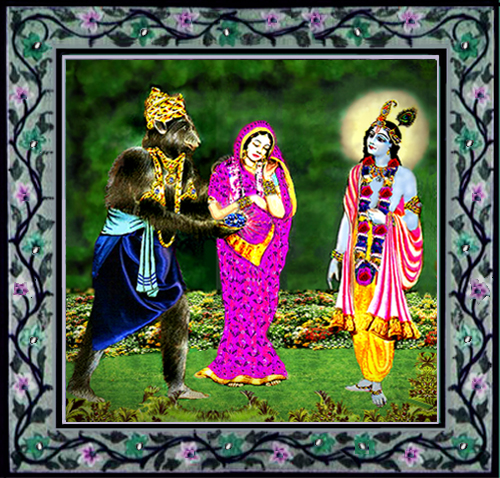
Brahmanda Guruji Shri Narendra Babu Sharmaji narrated the story how Lord Krishna was accused of stealing the Syamantaka gem and how He prayed to Ganapathy and the blame was removed and Krishna acquired the Gem and two wives as reward in his Brahmanda television programme telecasted in Suvarna News 24x7 Channel.

The story of the Syamantaka Mani shows how powerful the curse of Ganesha is. Satrajit of Dwaraka had a gem called Syamantaka Mani. It was dazzling and beautiful. If it was worshipped with devotion it used to give plenty of gold every day. Once, even Krishna asked to borrow it but Satrajit refused to lend it to anyone.

Once Prasena, Satrajit's brother, went out hunting. He was wearing the Syamantaka Mani. A lion killed him and went to a cave, carrying the gem. A bear by name Jambavan killed the lion and gave the Syamantaka Mani to his cub to play with. This Jambavan was not an ordinary bear; he was the heroic follower of Shri Rama.

When Prasena did not return to Dwaraka, Satrajit became worried. Satrajit then suspected that Krishna himself had killed him for the sake of the Syamantaka Mani. After all, he did want to borrow it. The rumor spread throughout the kingdom.

Krishna had not done anything wrong. So when he heard about Satrajit's doubts, he was angry. To prove himself innocent, he went in search of Prasena.

He found the corpse of Prasena. There were footprints of a lion nearby. Following these footprints, Krishna entered the cave of Jambavan. He fought with Jambavan for twenty-eight days. At last, Jambavan understood that Shri Krishna was Shri Rama himself in another form. He finally offered the Syamantaka Mani to Lord Krishna.

Krishna gave the Syamantaka to Satrajit and put an end to the evil rumors. However, he was still surprised at what had happened. "How could such things be said of me even when I had not done anything wrong?” Narada Muni told him the story of Ganesha's curse and said, "You saw the Moon on the fourth day." Krishna then remembered how he saw the reflection of the moon in a bucket of milk.

Then Krishna worshipped Ganesha. Siddhi-Vinayaka Vrata, the worship of Ganesha, is performed on the fourth day of the bright fortnight of the month of Bhadrapada. The devotees believe that those who see the Moon on that day will not suffer, if they listen to the story of the Syamantaka Mani.

The Legend Of The Cauvery River

with 0 Comment
The Legend Of The Cauvery River
This legend is of the river Cauvery and how it started flowing in southern India. To celebrate the glorious and auspicious marriage of Lord Shiva and Goddess Parvati, all the gods, goddesses and sages (Rishis) gathered at Mount Kailash, Himalayas. This mammoth gather caused the northern land to dip.

Lord Shiva asked the renouned sage Agastya (Agastya transliterated as Agathiar, Agasthiar and Agastyar. He is one of the Saptarishis) to travel to the south to stabilize this imbalance. He was told travel to Podhigai ranges in the southern parts of India to complete this task.

Sage Agastya was deeply saddened because he would not be able to witness Lord Shiva’s union. Lord Shiva, known for his gentleness and understanding towards his devotees knew what was in the divine’s sages mind. He told him that he would still be able to see the wedding celebrations from the south. Then from his matted locks, Lord Shiva took the river Cauvery and filled it in the sage’s kamandal (a metal pot with a handle, always carried by sages). The Lord told the river Cauvery to flow where ever the sage pointed. Bidding farewell to the Lord, sage Agastya travelled to the south and went to various pilgrimage sites of Lord Shiva.

Unknown to the sage, there were other events taking place in the south. A demon named Surapaduman had terrorized the gods, especially Lord Indra, the king of gods. Lord Indra was forced to leave his kingdom, Indralok and took refuge in a place called Sirgazhi where he prayed to Lord Shiva for help. He created a maginificent garden and worshipped him with the flowers from his garden.

The god of wind, Lord Varun too was frightened with the power of the evil Surapaduman and didn’t bring the clouds to shower rains in this region. There was drought and the flowers of Lord Indra’s garden wilted away. Helpless, Lord Indra was deeply distressed that his prayer to please Lord Shiva was interrupted. Sage Narada couldn’t see Lord Indra’s despair and told him about how the river Cauvery was in sage Agastya’s kamandal.

Lord Indra didn’t know how to seek the sage and get him to release the Cauvery River so he prayed to Lord Ganesh. Lord Ganesh, ever so loving, took the form of a crow and flew to sage Agastya and sat on his kamandal and toppled it. The sage raised his hands to shoo the crow and river Cauvery thought that it was a signal to start flowing and she did.

The crow then took the form of a small boy. The sage didn’t know it was Lord Ganesh and tried to strike him on his head with his knuckles. Suddenly, the boy changed his form and the sage came face to face with Lord Ganesh. He realized what a sin he was committing; he was trying to strike the Lord. In repent, he began striking his forehead with his knuckles. Lord Ganesh stopped him and said whoever prayed to him in this manner would be blessed with wisdom.

Another version of this story is that river Cauvery previously known as Ponni was disrespectful to sage Agastya and he punished her by trapping her in his kamandal. Sage Narada requested Lord Ganesh to free the river and so he took the form of a crow and toppled the kamandal. After this incident, the river Ponni was given a new name Cauvery also spelled as Kaveri.

Why Tulsi is not offered to Lord Ganesha?

with 1 comment
Why Tulsi is not offered to Lord Ganesha?
Ganesha is offered all sorts of sacred flowers, fruits and sweets in worship but not the Tulsi leaves, the sacred basil. Tulsi is very much venerated by hindus, specially the vaishnavas, but it is not offered to Ganesha because of a curse. A story says that once Ganesha was engaged in deep meditation on the banks of ganga on Vishnu. Ganesha resplendent in yellow robes looked very attractive. His body was besmeared with fragrant sandal paste and ointments. Costly jewels decorated his effulgent body. As Ganesha was thus engaged in prayers, there came Tulsi. As soon as she saw Ganesha, she fell in love with him and requested him to take her as his wife.

She said that she was the daughter of dharmatmaja and engaged in tapas in order to obtain a suitable husband. Ganesha then replied her humbly, “O Lady, marriage is a great source of all kinds of troubles. It disturbs the peace of mind and destroys tapas. Therefore I cannot marry you. I have vowed to remain celibate ever engaged in prayer and penance. Kindly choose some one else for your spouse.”

Why Tulsi is not offered to Lord Ganesha?
These words of Ganesha annoyed Tulsi. She took it as her insult and got angry. In her anger she cursed Ganesha saying, “You will definitely get married against you wishes”. Ganesha, the best of the gods cursed her in retaliation saying, “You would be possessed by a demon in marriage, and then under a curse from the saints become a plant”.

On hearing this curse, Tulsi grew repentant and praised and prayed Ganesha. This softened and pleased Ganesha and he said, “O Tulsi, you will be regarded supreme among the plants. All the gods will love you, but you will be specially dear to Krishna. Whosoever worships the lord with your leaves as offering would achieve liberation in heaven, but you will always be unacceptable by me.” With these words Ganesha engaged himself in meditation. Meanwhile Tulsi retired to Pushakara, the holy lake and began severe tapas. Later under ganapati's curse she became the wife of the demon king called Shankhachuda. She lived with him as his beloved wife, but then her husband was killed by Shankara and she turned into a plant of holy basil, so dear to Lord Hari.

Goddess Lakshmi and Lord Shani

with 2 comments
Goddess Lakshmi and Lord Shani
Once travelling in the galaxial path, mother Lakshmi happened to meet Shani deva. Both being very top authorities of the universe, entered to into an argument as to who must leave the way for the another. Ending into a no-acceptable solution, they reached out to Indra, Brihaspati & then to the most respected trinities. But, the confused trinities were too not able to converge to a good decision.Finally, Lord Vishnu suggested to reach none other than devarshi Narada, who alone could pacify the candidates.Narada appeared there & then. Hearing to both sides, he requested Lakshmi devi & Shani deva to walk together to & fro as many times as they could !.

Goddess Lakshmi and Lord Shani
In the course of their walk, Narada use to appreciate in a loud voice - "Very nice ! Very nice ! ..... "To this, the trinities with others run to Narada & ask who is supreme.Narada smiled & then replied - "I have observed Lakshmi devi & Shani deva very minutely. Their walk styles are highly attractive. It gives me equal comfort when I witness them here or anywhere. I rate them equal hence. "But this was certainly not an expected outcome for anybody round there. The annoyed devas asked Narada to pacify them with a more intellectual reply.

Narada disclosed - "Though the walk styles are equally attractive, still, there is a difference !! "And, what is that difference? "It is nice to see Lakshmi walking towards me & Shani walking away from me." (i.e it is good while Goddess Lakshmi entering once life and it is good while Lord Shani leaving once life) "Therefore, the enjoyment is entirely time/requirement dependent...." "Time & time alone distinguishes the importance of Lakshmi & Shani. They are equally respectful otherwise & else. "Pacified devas & trinities supported Naradas's brilliant view of tackling the problem in one voice.On the other hand, Lakshmi & Shani also blessed Narada & saluted each other also.

Bhima Meets Hanuman

with 0 Comment
Bhima Meets Hanuman
While in exile, Bhima once had to go out by himself on a mission. Passing through the dense forest along a narrow path, he came by a small old monkey lazing wayside with its long tail stretched out on the path.

Looking at Bhima, the monkey addressed him thus: Are you not the great Bhima? My salutations to you!

Bhima was, understandingly, surprised to come by a talking monkey and said with pride: Well, I am glad you recognise me. Now move your tail away so I can pass by. It is not wont of me to walk across any creature.

The monkey said: Oh, dear, don't you see how old and sick I am? Will you please oblige and move the tail yourself?

Bhima, thinking it rather unpleasant to touch a monkey and that too its tail, stuck out the little finger of his left hand and pushed it. But the tail did not move. Hiding his surprise, he used his whole left hand and tried pushing it. Yet it did not budge a mustard seed's width. To one endowed with the strength of eight thousand elephants, this was too much! Feeling crushed, yet hiding it, he used both his hands to push the tail but to no avail. Suddenly it dawned upon his not-so-brilliant intelligence that it was no ordinary monkey that he was dealing with.

He fell at the monkey's feet and said: Oh, mighty one! I beg of you to reveal your true identity to me. I am your humble servant!

Shedding his disguise, Chiranjeevi Maruti, son of the Wind god and Bhima's brother, revealed himself.

He blessed Bhima saying: Shed your pride and take refuge in the Lord. You shall be victorious! My power shall always be with the Pandavas. I shall ride upon Arjuna's flag.

Bhima bowed down to his brother in all humility.

Humble Devotion is Worth more than Material Wealth - Satyabhama's Tulabharam

with 1 comment
Humble Devotion is Worth more than Material Wealth - Satyabhama's Tulabharam
The palace of Dwaraka ever twinkled with the presence of Krishna’s many wives. Rukmini, Sathyabama, Jambhavathi and all the others went about their usual chores serving Krishna and all the others of the extended Yadava clan. With the blessings of the goddess of wealth, the treasuries of Dwaraka always overflowed with jewels and precious stones. Sathyabama was the beautiful daughter of Satrajith, the owner of the sacred Syamantaka jewel. She was haughty and proud of her royal lineage and good looks. She prided herself on her pure love for Krishna and yet she was jealous of Rukmini, the goddess of wealth incarnate. Rukmini on the other hand, being the first queen of Dwaraka was a very humble lady and a pious wife. She let nothing come in the way of her devotion to Krishna and served him with whole hearted love and devotion.

One day, the divine sage Narada, the creator of mischief, came to Dwaraka to offer his salutations to Sri Krishna. In the courtyard he met Satyabhama, beautifying herself with some flowers on her tresses. He walked up to her and with a voice of absolute innocence asked her, “Rani Satyabhama, dont doubt my intentions, but is it my old age or is it really true that Krishna loves Rukmini more than you?” Sathyabhama was thoroughly shaken and stood still, gaping at Narada.”You are far more beautiful and charming than her. You are the younger queen. Dont you think you deserve more attention?”, prodded Narada again. Pulling herself together, Satyabhama looked inquisitively at Narada, “Tell me divine sage, what should I do to gain his undivided attention? You are my only hope now”, she pleaded to him.

Rishi Narada arrived in Dwarka and in the course of conversation hinted to Satyabhama that the love that Krishna exhibits towards her is not all that real and in fact it is Rukmini(the first wife of Krishna) who has real control over his heart. Unable to bear this, Satyabhama challenged Narada to prove it. Narada, with his way with words, tricked her into accepting a Vrata (ritual) where she has to give Krishna away in charity to Narada and reclaim him by giving the weight of Krishna in wealth. Narada lured her into accepting this vrata by telling her that Krishna’s love to her will increase many folds if she succeeds in performing this Tulabharam. He also instigated her ego by hinting that her wealth may not be sufficient to equal the weight of Krishna. With Satyabhama's ego duly raised, she told Narada that she can mobilize so much wealth that it is a child’s play for her to outweigh Krishna. Narada warned her that if she is not able to do this, Krishna will become his slave to be done with as he pleases.

The scene was soon set for the vrata. Satyabhama gave Krishna away in charity (dana) in spite of the other wives’ pleadings. Krishna, always the mischievous cowherd, meekly submitted to this drama. After donating Krishna to Narada, Satyabhama arranged for a big scale to be put up and sends with all assurance for her huge treasure of gold and jewellery. All that she has is soon put on the scale, but it didn’t budge. Narada started taunting her and threatening her that if she can’t put enough gold or diamonds, he will be forced to auction Krishna as a slave to someone else.

Satyabhama, in frantic panic, swallowed her pride and begged all the other wives to give their jewels. They agreed out of love for Krishna but alas, it is of no use.
Krishna remained a mute witness to all this drama and rubbed salt into the open wounds of Satyabhama’s ego that he has now to become a slave to some cowherd and will have to suffer the separation from his dear wife. Narada suggested to Satyabhama that Rukmini may be able to get her out of the predicament. She finally swallowed her pride and appealed to the devoted first wife of Krishna. Rukmini came and with a prayer to her husband put a single leaf of the sacred Tulasi on the scale (tula). Lo and behold, the scales became all at once so heavy that even after removing all the jewels, the scales were weighed down on the side of the Tulasi leaf.

While there are different versions in different texts as to why the weighing was arranged, the story of the Tulsi leaf placed by Rukmini being worth more in weight than that of Satyabhama's wealth is a common ending. This story is often repeated to enunciate the significance of Tulsi and how a humble offering to God is greater than any material wealth.

Lord Krishna Defeats Indra by Lifting Govardhan

with 0 Comment
Lord Krishna Defeats Indra by Lifting Govardhan
In the country of India, there is a little town called Brindavan. It is a famous and a very holy place for it is associated with the birth of Lord Krishna. The holy God was born there 5000 years ago. He was born on the earth as an ordinary human being, to punish the wicked and protect the good.

It was the rainy season. The sun was smiling weakly behind dark clouds. Brindavan, then a charming village, was transformed into a lush heaven with healthy, greener vegetation and plenty of rains for the people. Everyone in the village was happy.

Krishna woke up with a start. It was not yet morning, but the sounds coming from the streets were loud and noisy enough to wake one up. Curious, he got up and peeked outside his window.

A crowd had gathered before his house. Several men and women were sweeping the streets clean. The roads were being decorated with garlands and lamps.
Krishna was surprised at the sight, as he had seen since his birth that in the rainy season, the villagers slept till late in the morning.

"Is it a festival today? Or is anybody getting married?" he wondered. But he couldn't remember any such occasion.

He left his home to take a bath in the river. While coming back, he saw his father Nanda overseeing the men in the streets.

"Father, what is happening on the streets?" Krishna asked his father.

"The Gopalas are preparing to celebrate a festival to worship Lord Indra," said Nanda. "This year, there has been a rainfall more generous and everybody is happy with the fertile crops. Since Indra is the God of rains, we should thank Him for being so gracious in his blessings!"

"How do you say that Lord Indra is the one who's causing rains, Father?" Krishna frowned in disagreement.

Nanda looked at his son in alarm.

"Of course it's Indra who's causing the rains, son. He is surely the reason for our good fortune. He's the God of the Clouds and he rules them... so he is the one who has blessed us with good rain this year," he replied hesitantly to his son.

"No, father!" refused Krishna firmly, "you're all mistaken. Govardhan Mountain is our real friend. More than the clouds above, the mountain in our village has helped us."

"How can you say that?" asked Nanda, looking at his son in disbilief.

"The fertile mountain sends the signals in the air and creates clouds that drift over the Brindavan and give us rains." replied Krishna. "So whom should we praise and worship? Not Indra, but Govardhan!"

Nanda and the other Gopalas at work gasped in surprise. How could Krishna dismiss Lord Indra, God of the Clouds and direct them to worship a mere mountain instead! This was the first time that they heard about such a thing.

"Yes, father," continued the boy. "Who gives us medicine in the form of magical herbs and plants? Who sends us clean water and air from the top of its peak?
"And who gives us good grass for our cows, so that they give us milk that's sweeter than honey? It is Govardhan!"

The initial surprise and doubts of the Gopalas were beginning to disappear. They now began to see Krishna's point.

"So why should we not worship the mountain?" Krishna continued. "It is wiser to give thanks to something which is right before us, rather than some deva who lives comfortably in the heavens."

Hearing Krishna's words, the Gopalas were totally convinced. They all agreed to worship Govardhan that year, instead of Lord Indra. But Nanda was apprehensive, for he feared that this shifting of loyalty might incur the wrath of God upon them.

And his fear came true. Up in the skies, Lord Indra was listening to this conversation in anger and fury. "So that little cowherd boy has stopped the celebrations in my honour!" he thought in indignation.

Lord Indra's pride was insulted by the Gopalas' decision to worship Govardhan, instead of him. In his anger, he decided to punish the people of Brindavan.

"All these years I have heard their plea and helped them to prosper. And is this what I get in return? It's time they know who the real God is here! I'll send the most dangerous rains and thunderstorms to Brindavan," he thought cruelly. "They will destroy the whole village of Brindavan. Let them see who saves them then!"

What he thought he soon realised in action. Using his divine powers, Lord Indra created clouds that seemed to be darker than the midnight sky. They looked devilish and fearsome.

"Go and destroy Brindavan!" he ordered.

And they heeded their Master's command. Without any delay, they grouped together to form a menacing army of clouds and raced towards the village where Krishna and several innocent families lived.

"This will be enough for them" thought Indra and laughed aloud.

After a delicious lunch, the people of Brindavan were dozing in their homes. Suddenly they heard a terrible sound.

Crasssssssssshhhh!!!

Everybody was alarmed and came out of their homes. What they saw outside took their breath away.

It was noon in Brindavan, but nobody could say it was so. The whole village had become pitch dark. The sun was nowhere to be seen. Instead, black and terrible looking clouds had invaded the village. They enveloped the whole place in a thick mist, darkening the day, making it gloomy.

The clouds looked evil and menacing, but they stood suspended in air and didn't rain. It seemed as if the clouds were waiting for somebody, or rather, for some signal.

The people of Brindavan watched in fear and awe. They were spellbound. Nothing like this had ever happened in their lives!

Krishna heard the frightened voices of the villagers. He was curious and came out of his house. But as soon as he stepped out, there was a great roar and the black clouds poured rains over Nanda's house. It seemed as if this was what the monstrous clouds had been waiting for.

The demonic clouds seemed to have some fiendish scheme. From Nanda's house, they quickly spread themselves over the town. The dark sky seemed to open with a vengeance. Hard rain came down in torrents, flushing away the cattle and the frail huts. The mere thatched roofs were no match for the terrible downpour.

"Run! screamed a man in terror and people started to run for their lives. They ran in all directions, to save their family and belongings. But even escape seemed difficult for the Brindavan people. The hard and blinding rain lashed over their faces, as if giving slaps for some unknown offence. Nowhere could they take any shelter for nothing seemed to be strong enough against this mighty cloudburst. The innocent and helpless people wailed in the face of such a calamity. They prayed for some divine help.

But the clouds were merciless. They now had the support of blinding lightning and ear-splitting thunder.

Every now and then, lightning struck a fertile tree and destroyed it. Thunder rumbled throughout the ordeal, shaking' people's nerves and panicking them. Nanda felt helpless on seeing his people panic.

"Do you see, son? This is no ordinary rainstorm. This seems to me to be the punishment of our transgression. It is difficult to escape the wrath of Gods. That is why we worshipped Lord Indra all these years, Krishna," he said to his son gravely. "Because we decided to ignore Lord Indra this year, he's punishing us. Now, innocent people are suffering because of your idea... what to we do now?"

Krishna looked at the skies. "Ah, vain Indra!" he thought in fury. "I understand your plan. You want to teach us a lesson, don't you? But first, you need one! And soon I will crush your ego."

Thinking so, Krishna laid a reassuring arm on his father.

"First, we need to focus on making the people see reason, Father," he said and walked to the centre of the town. Using his most commanding voice, he called out:

"O people of Brindavan. Look at me. Do not run. Do not panic!"

The Gopalas looked at Krishna miserably. They had known the boy for long. They knew that he was not an ordinary mortal and possessed some mysterious powers.
But what can the boy possibly do in such a situation?

"This is all our fault!" somebody murmured. "We insulted Indra and now he's punishing us," continued another.

"Yes uncle Guran, what you say is right. This is indeed an evil plot of Lord Indra," replied Krishna, looking at the man. "But like before, Govardhan would help us once again. Come this way and I will show you how!" he declared and led them to the mountain.

Lord Krishna Defeats Indra by Lifting Govardhan
Krishna looked up and smiled at the clouds. And in a blink of the eye, he lifted Govardhana Mountain, like an umbrella over the people.

People forgot to breathe. A small boy had lifted a mountain on his little finger!

Up above, Indra was bewildered. "How can a mere child lift a mountain?" he thought. He hadn't ever seen such a feat achieved by anybody, leave alone a child.

"You should have understood it by now. But you did not. Pride and arrogance has clouded your common sense, Indra!" sounded the voice of Brahma.

Lord Indra looked at the God of Creation in confusion.

"Don't you know that Krishna is a divine child?" continued Brahma. "Aren�t you aware that he's an incarnation of Lord Vishnu? Shame on you!"

Indra was humbled and stopped the rains. As a sign of his apology, he ordered the clouds to shower rose petals from the skies. Then the applause began.

Every Gopala whooped in delight at their darling boy for his strength and wisdom. They now saw what a godly child lived amidst them. They composed songs in praise of the Lord, singing of this miraculous feat. Shouts of "Long Live brave Krishna!" seemed to echo everywhere.

And it continues even today.

Story Behind Distributing the Sesame Mixture On Makara Sankranti

with 0 Comment
Story Behind Distributing the Sesame Mixture On Makara Sankranti
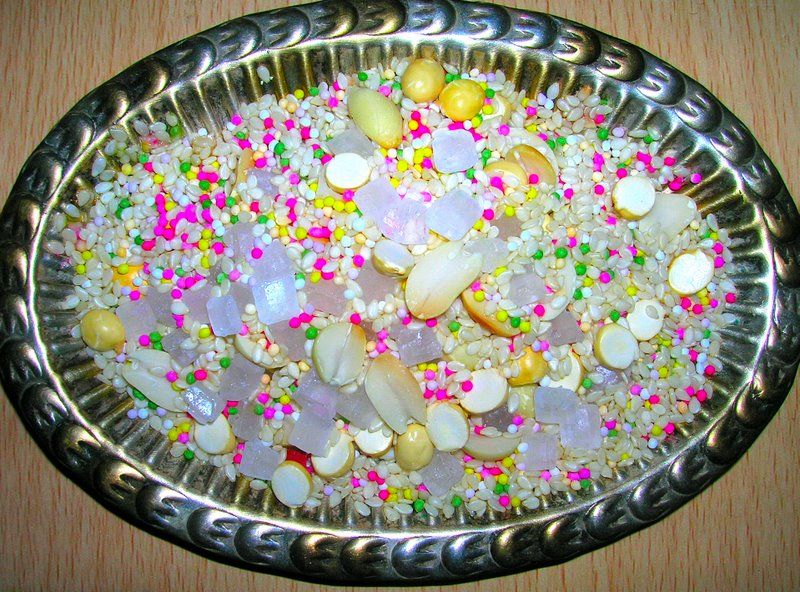
Long ago, a demon by name Tilaasura (tila means sesame and asura means demon in Sanskrit), pleased Brahma by his intense penance. Brahma granted him many boons. Tilaasura became arrogant with his immense powers and started harassing everyone in the three worlds.

The assembly of gods prayed to Surya and beseeched Him to save them from the terrible demon. Surya asked his commanders, Makara and Karka to attack Tilasura.

In the ensuing battle, Makara pierced open the demon's stomach and killed him. From Tilasura's ruptured stomach poured out the nourishing sesame grains.

Surya was pleased with Makara for saving the living beings and releasing the trapped grain. The Lord Sun said: "Whoever, on Makara Sankranti day, worships Me and distributes sesame will be blessed with all prosperity!" Ever since, the custom of distributing the sesame mixture came into existence.

Why Snakes Have Forked Tongues?

with 0 Comment
Why Snakes Have Forked Tongues?
Kashyapa’s wives Vinata and Kadru gave birth to Garuda and the nagas respectively. Once Vinata said that the tail hairs of Indra’s horse Uchaishravas were all white, Kadru maintained that it was black. It was agreed that whoever lost would become the other’s slave. As per Kadru’s instructions, a few nagas clung to the horse’s tail and made it appear black. Thus Vinata became Kadru’s slave and Garuda had to take care of Kadru’s children.

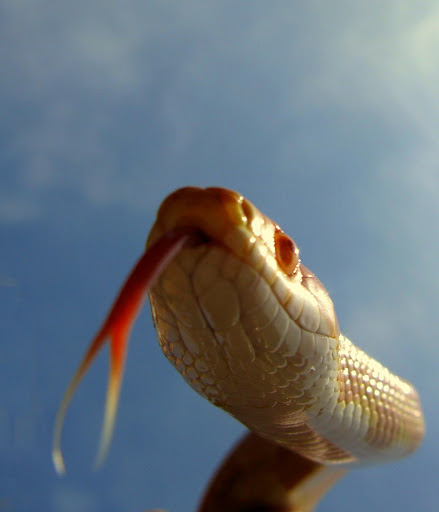
Kadru said that she would end the slavery if Garuda got the amrit from devaloka. Garuda defeated the devas and got the amrit. The nagas kept the amrit on darbha grass and went for a bath. During that time, the devas took back the amrit. When the nagas returned, they couldn’t find the amrit, but they were so filled with lust for it that they began licking the grass. Their tongues were torn and that’s the reason why snakes have a forked tongue. Kusa grass became sacred also!

The Birth of Shri Dattatreya - Datta Guru

with 0 Comment
The Birth of Shri Dattatreya - Datta Guru
Shri Dattatreya is a very ancient incarnation, highly venerated through the ages. Dattatreya – a Universal Guru manifested in the recess of time of 'Kaliyug', when humanity had gone far from its pristine state and steeped into threshold of a timewhen all kinds of vices had already taken root, and the pious souls made fervent appealed for the salvage of the mankind surging forward in manifold way. He had descended on this earth to establish 'Satya' (the Universal Truth), 'Rta' (the CosmicOrder), Dharma', (the perennial principles), in all its entirety.

Seer Atri was one of such Seers who had ‘seen’ and experienced the Brahman, the eternal Wisdom. To him was born a son, the product of the Grace or the Divine Will, which was the manifestation of all three Primal Energies ofBrahma, Vishnu and Shiva. He was ordained with the three energies; He came to have the concentrated wisdom of the three God-heads or symbolically three heads. The three heads signified as Brahma:‘Tejas’ personified, Vishnu:‘Ojas' personified, Shiva: ‘Tapas’ personified. Under these heads, illumination of knowledge, vigorosity of action and stringency of penance were represented as three aspects or state of being of the same.

Dattatreya had descended into the realm of world as progeny of Atri and Anusuya, a sage couple of the Vedic age.
Anusuya became very famous for her devotion to her husband. She was the embodiment of chastity. Such was her spiritual power that hard, uneven earth turned soft and smooth for her as she walked about. This pious woman induced jealousy and envy in others, however, and the three Gods decided to prove these doubting elements how wrong they were.

They transformed themselves into mendicants, approached the hermitage of sage Atri and begged for alms. At that time sage Atri was away at the river offering his daily oblations. Anusuya came out and offered food to them. They made a strange request; the food be prepared and served to them by Anusuya, in the nude. In the Indian tradition any 'athithi' (guest) cannot be turned away, as they are considered to be an aspect of God. Hence she was placed in a dilemma. She smiled to herself and reflected thus: ‘I am totally purified by the long association with the holy sage Atri. What harm can the god of lust ever do to me? So I do fear nothing. As they have sought food from my hands, I look upon them as my own children and not as strangers and grown up men!’ Her thoughts – the thoughts of a pious and chaste person – instantly became reality; the elderly guests became babies!

Sage Atri on his return to the hermitage saw his wife Anusuya fondling three babies. Anusuya said "These children are the gift of God to us who have been childless so far". Sage Atri was overjoyed and named them Datta, which means 'given'. At this the three Gods reverted to their real forms and disclosed the truth. They extolled the power of chastity and purity of Anusuya which vanquished the combined and colossal powers of all three of them. Sage Atri and Anusuya prayed that they should remain as their sons. They consented and the three Gods merged into one body.
This is how Shri Dattatreya incarnated and is known as Gurudeva Datta – the Guru of all Gurus.

Daana Veera Soora Karna

with 0 Comment
Daana Veera Soora Karna
This is a short story taken from the epic Mahabharata by Veda Vyasa.

Once upon a time there lived a king called Karna. He was famous for his kindness and charity in his Anga kingdom and was popularly known as Daana Karna (Karna the great giver). He has setup a charity bell in his kingdom, people who are in need can ring the bell and get what they need from the king.

Duryodhana heard about the charity work by King Karna and wanted to try his hand in charity as he was an emperor of the world at that time to prove he is greater than Karna. He too setup a charity bell and started overgenerous charities, thinking himself a great giver.

Indra, the lord of the heaven wanted to prove the world who the great giver is. He created continuous heavy rains for about a week. Then he, in the disguise of an old man, went to Duryodhana and requested ten carts full of dry firewood. Duryodhana sent his men to the forest to get the requested, but they could not get any firewood due to the recent heavy rains. Duryodhana pleaded his inability to provide him with the firewood. Then the pseudo old man approached Karna with the same request. Karna also sent his men to the forest to get the firewood for the old man, they too returned unsuccessfully. Then Karna demolished part of his palace to pull out the wooden beams from the roof and fulfilled the wish of the old man by giving him ten carts full of dry firewood. The pseudo old man carried those firewood passing before the gate of Duryodhana's palace. Duryodhana was ashamed and he ordered his men to take off the charity bell as he doesn't deserve to do charity. Thus, the Karna was proved to be the Great giver.

This story was narrated by Brahmanda Guruji Shri Narendra Babu Sharmaji in his Bruhat Brahmanda Programme telecasted in Zee Kannada on the day of mitra sapthami.

Nachiketa and Yama

with 0 Comment
Nachiketa and Yama
Upanishads are ancient Hindu literature based on the dialogue between a realized soul acting as the teacher, Rishi and a sincere seeker of truth who approaches him as his disciple.

In Katha Upanishad the teacher is Yama -the death himself and the student is a young Nachiketa in his teens. This Upanishad, which consists of 120 verses, is one of the most popular Upanishads known for its simplicity and clarity in making the subject matter regarding the Highest Truth easily understandable.

Once upon a time there lived a braahmana named Vajashrava (Uddaalaka), who wished to accumulate punyam by performing a great yagnyam. The yagnyam was duly performed, but when the time for the daanams came, Vajashrava kept all the healthy cows for himself and gave away only those that were old and infirm. His son, Nachiketa, who was observing this, became very sad. He wanted his father to get the full phalitham for the yagnyam. He knew from shaastras that one must always give away things that are good, which will help others and the ones most liked by the donor. He went to his father and with great humility said thus: “O Father! Why are you donating only old cows that cannot give milk and cannot help the daana-grahitas? As you know, such an act is a great paapam. Your intent was to accumulate punyam. These gifts will have the opposite effect. Please donate your best of the cows”.

Vajashrava became angry. He said, “Son, You are not yet of an age when you can understand the ways of the world. If I donate all our good cattle, how will we live?” Nachiketa was silent for a while, for he had been brought up to give respect to his parents and elders. At last he said to his father, “O Father! The shaastras say that one’s child is the greatest wealth for him, hence give away me to somebody in order to fulfill the daanams in the yagnyam”. Vajashrava, who was busy with the yagnyam did not pay any attention to his son and on being repeatedly questioned by Nachiketa, out of sheer exasperation, Vajashrava shouted: “I hereby gift you to Yama”.

Nachiketa immediately started for Yamaloka, in order to make his father’s words true. He crossed the Vaitarani nadi, which even great aatmas who did a lot of punya also, find it difficult to cross! He reaches the dwaaras of Yamaloka and on knowing that Yamadharmaraaja was not in Yamaloka then, waited patiently for his arrival. The small boy waited near the dwaaram for three days without any food and water. Yamadharmaraaja returned on the fourth day and saw little Nachiketa at his doorstep. He felt pained for keeping an Atithi, that too a braahmana and that too a baalaka waiting without welcoming him, without food and water. Obviously Yamadharmaraaja knew that it was a great paapam not to welcome an atithi at the doorstep. Along with His wife, Yami, He rushed to serve Nachiketa. One went to fetch water and the other brought an aasanam for him. Yamadharmaraaja still did not feel completely satisfied in serving him. So he told Nachiketa, “Dear child, I have offended you by keeping you waiting for three days. To wash my paapam I request you to ask for three varaas”.

Nachiketa was very happy to recieve varaas from non other than the Yamadharmaraaja. Nachiketa said “My first wish is, when I return home may my father’s anger go away, may he conquer anger and always have prashaantata”. Yamadharmaraaja was very happy with nachiketa for his self-less wish. Nachiketa said “my second wish is to grant me the vignyaanam and my third and last wish is to grant me Aatmagnyaanam”. Yama granted the first two boons immediately and tried to convince Nachiketa to give up his third wish. Only a deserved person must be taught Aatmagnyaanam and hence Yamadharmaraaja tested Nachiketa by offering him gold, pearls, coins, horses elephants and even the happiness of Swarga instead. “No, I do not wish for anything else,” replied Nachiketa firmly. Finally, Yama granted him the third boon too, and Nachiketa was enlightened with the Aatmagnyaanam”.

Morals in the Story:

  • Pitruvaakya paalanam is the foremost duty of every child. This is well displayed by Nachiketa. Even though he had to face difficulties because of it, in the end he learnt the Aatmagnyaanam, which is difficult for even great sages to obtain.

  • The shaastra gnyaanam of Nachiketa helped him talk wisely both with his father and Yamadharmaraaja.

  • Dhiraas never give up, they never move away from the goal. This quality is displayed by Nachiketa both while travelling to Yamaloka and being firm during Yamadharmaraaja’s test before giving Aatmagnyaanam.

  • The importance of Atithi seva is well illustrated by Yamadharmaraaja.

  • Always we must give away things we like, which are good and not the ones we hate and are useless.

Story of Draupadi And The Mango

with 0 Comment
Brahmanda Guruji Shri Narendra Babu Sharmaji narrated this story of Draupadi in his Bruhat Brahmanda Programme telecasted in Zee Kannada TV Channel.

During their wanderings in the 13 years of exile, the Pandavas and Draupadi came upon a lovely ashram with many trees laden with fruits. They decided to rest in that spot for some time. Suddenly Draupadi’s eyes fell upon a mango dangling unseasonal from a branch. She asked Arjuna to pluck that mango for her. Arjuna shot a divine arrow and brought that mango to his beloved wife.

As she was about to eat the mango, Lord Krishna appeared and told them that they had committed a grave misdeed. Yudhishthira grew most anxious and asked Krishna what he meant. Krishna told them all that the ashram belonged to the sage Sandipan who even the gods and the demons feared.

“For ages Sandipan muni has lived in this forest. Every day at dawn, he leaves for his meditation and fasts the whole day. Every day a single mango ripens on this tree. When the muni returns in the evening, in great satisfaction he plucks the mango from the tree and eats it. Returning from his penance to the ashram and not finding the mango, the muni will turn you all into a heap of ashes. Alas, Partha, what have you done?” said the lord.

With folded hands king Yudhishthira, asked Krishna a way to save them all from Sandipan’s wrath. Hearing his words, the lord said: “If the tree appears just as it was when the mango was on it, then all can be saved, O king.” When the eldest Pandava asked him how that miracle could be achieved, Krishna told them that that if they all spoke the truth about whatever was uppermost on their minds at any given moment, the mango would go back to the place it came from. All six of them undertook to do as Krishna asked them to.

First spoke Yudhishthira: “Every day I think that if only I could regain my past prosperity, day and night I would perform Brahmin-feeding yajna.” The unseasonal mango rose upwards to some extent, astonishing everyone.

Then said mighty Bhima: “This is what I think day and night: with blows of my mace, I’ll slay the hundred Kauravas. I will shatter Duryodhana’s thigh with my mace, and rip open wicked Duhshasana’s breast with my nails.” When Bhima had spoken, the mango rose further upward.

Aruna said: “This rises in my mind all the time: that with weapons as numerous as the dust will I cut down the wicked Kshatriyas. And I will slay valiant Karna with a divine arrow.” Then the mango rose further upwards. Now it was the twins’ turn.

Nakula said, “Ever I think that when the ruler of Dharma will be king again, I will examine and report to him the kingdom’s good and ill.” Sahadeva said, “Ever I think of how returning to the kingdom I will forget all sorrows in looking after our mother.” Then the mango rose further upwards, almost touching the branch.

Then, slowly, softly, spoke Draupadi: “This is what I think of day and night: all those wicked persons who have pained me so much, at the hands of Bhima and Arjuna, they all shall be slain. All their women will weep in sorrow and I, delighted, will secretly mock them.” The moment Draupadi said this, the mango dropped to the ground again.

Terrified, Yudhishthira burst out: “Why did the mango fall down? Tell us, Krishna.” The lord replied: “Drupadi ruined everything - she spoke all false words.” Hearing this, Arjuna became furious and strung an arrow on his bow. He said: “Quickly speak truthful words, otherwise I’ll slice off your head with this sharp arrow,”

When Arjuna spoke thus, Draupadi spoke the truth casting aside shame: “Lord, what shall I say? You know the spoken and unspoken thoughts of all. When I saw heroic Karna at the syayamvar, since that day I often think that had he been Kunti’s son, then I would have had six husbands.” When she said this, the mango shot up that very moment and was on the branch of the tree as previously. Acknowledging this a miracle, all were delighted.

But mighty Bhima, who loved Draupadi the most roared with anger, “Is this your conduct, evil-minded woman? You have five husbands, yet you secretly desire one more? What made you turn to such evil ways? As long as your mind and heart favour the enemy, who can trust you?” Saying this, lifting his mace, in mighty fury Bhima rushed to slay Draupadi.

With a slight smile, the lord seized Bhima’s hands. Then he said: “Without cause do you slander Draupadi. She spoke not what she desired but what she feared. The cause of this is secret and it is not proper to reveal all now. After the king has returned to his kingdom and has sat on his throne, then will I specially reveal all to everyone.”

Hearing this response from Krishna’s mouth, heroic Vrikodara sat down restrained. And they all thought about what Krishna said as he prepared to take his leave. But this was all his maya: Draupadi had always prided herself as the supreme sati nari, and to break her pride was all this arranged by the lord.

Gautama Maharishi And Ahalyaa

with 0 Comment
Once Brahmaa took all the most beautiful things from all of his creation and created a woman and named her Ahalyaa, means without deformation. All the Devtaa wanted to marry her, so Brahmaa Jee decided that whoever could go around the three worlds first would marry Ahalyaa. Indra used all his magical powers to go around the three worlds, finally reaching Brahma to take the hand of Ahalyaa.

However Naarad mentioned to Brahma Jee that Gautam had in fact gone around the three worlds even before Indra. Naarad explained that as part of the daily Poojaa, Gautam went around the cow at his hermitage. On one of the days when he went around doing his Poojaa, the cow gave birth to a calf. As per the Vedas, the cow at the time of bearing a calf is equal to three worlds, hence Ahalyaa must be given to Gautam and not to Indra. So Ahalyaa was given to Maharshi Gautam. Since then Indra was envy with Gautam Rishi and had intended to have her.

Thus Ahalyaa was the wife of Gautam Rishi and was a Pativrataa (loyal to husband) woman. They had a son named Shataanand (he was Seetaa's father Raajaa Janak's Purohit). Dev Raaj Indra was always seeking the opportunity to have her after Brahmaa had given her to Gautam Rishi, but was afraid of her Paativrat Dharm. So one day he assumed the form of a cock and crowed before time (normally he crows at 4.00 am, but on that he crowed befoe 4.00 am). Gautam Rishi used to rise in the morning when the cock crowed, so when he heard the cock's crow he went out for his daily chores. In the meantime Indra came in the form of Gautam Rishi and expressed his desire to Ahalyaa. Ahalyaa was very surprised to see Rishi returning home so soon and hear this strange proposal from Muni, but since she was a Pativrataa woman she considered to obey her husband. Thus Indra had her.

When Indra was coming out of the Aashram, he met Gautam Rishi at the door. Both saw each other. Indra was frightened so he ran away. Muni understood everything, he came inside. Seeing Rishi Gautam again Ahalyaa got frightened and understood everything. She fell on the feet of Gautam Muni and asked for his forgiveness as she was caught innocent. That was not her fault. But Muni was very angry and he gave Shaap to her, "Be a stone". Then later he relaxed it with "When Bhagvaan will take Avataar in Ayodhyaa in Tretaa Yug and will pass from here, you will again become the woman by the touch of His feet's dust."

Then he cursed Indra - "Since you looked at my wife with bad intention, your body should be full of the marks of vagina." Indra did severe penance toward Shiv. Shiv gave him the boon to convert that mark of female organ to that of eye. From that day Indra is called Sahasra-kshan - the one with thousand eyes.

Janamejaya’s ‘Sarpa Yagna’ (Snake Sacrifice)

with 0 Comment
Janamejaya’s ‘Sarpa Yagna’ (Snake Sacrifice)
King Janamejaya the son of King Parikshit was the king of the Kurus, ruling from Hastinapura. One day, a Brahmana named Utanka, came to his court. The king received him graciously, and asked him if there was something he could do for him.

Utanka said, "You amaze me King Janamejaya. When the murderer of your father is roaming around free, you sit at ease in your court and enjoy the the comforts of a King. You have acquired fame as a just King, but I see no evidence of it. You have not even addressed this great injustice to your father!" not addressed this great injustice done to you."

Janamejaya was surprised. He turned to his counsellors and sad, "What is this about my father's murder. I was but a child when he passed away, I no naught of the circumstances behind his death. I would like to know if he was killed unjustly, and if so, who the culprit is."

The courtiers said, "Your father Parikshit ruled the kingdom after the Pandavas and ruled for a long time truthfully. He was popular among his subjects and was a terror to his enemies. He was killed by Takshaka, the king of the serpents, pursuant to a curse by the son of a Rishi(sage). What Utanka has said is true, Takshaka, the murderer of your father still roams free.

When Janamejaya heard these words, he was rendered speechless for a while due to anger. Once he regained control over himself he said to Utanka, "O Brahmana, I thank you. You have brought this great injustice to my attention. I must revenge myself on this arrogant Takshaka at once. Tell me, what is the means by which I might accomplish this task?"

Utanka replied, "Takshaka is the friend of Indra. Under Indra's protection, he feels safe from retribution, so his conceit has grown boundless. However, there is a great sacrifice mentioned in the Puranas. It is the snake-sacrifice. When this sacrifice is conducted, the snakes that are named by the Mantras (incantations) will be rendered powerless and be impelled to fall into the sacrificial fire. Make arrangements to conduct this sacrifice. I shall assist you, for Takshaka has caused trouble for me also. He once stole the ear-rings that I was taking for my Guru Veda's wife. I had to face many difficulties in recovering them. So both our wishes may be accomplished by this sacrifice."

King Janamejaya then made arrangements for this sacrifice. He invited the greatest sages and priests to conduct this sacrifice. This was a truly great undertaking, for the rituals for this sacrifice were arduous, and had to be exactly followed, if the sacrifice was to bear foot. A suitable spot was chosen and the great sacrificial hall was constructed. A platform was raised in its midst and was decked with valuable articles. This was were the Brahmanas were to sit. The Ritwika (officiating priest) sat in its middle. The king also underwent the rituals that will purify him to participate in the sacrifice.

While these preparations were on, a Shudra named Lohitaksha, who was well versed in the art of sacrificial construction, examined the measurements of the hall, the type of soil on which its foundation had been laid, and said, "O King, I perceive from these signs that your sacrifice will not be completed. The omens portend that this sacrifice shall be stopped due to the intervention of a Brahmana."

This made King Janamejaya recall an incident where his brothers had beaten a small dog for fun in times gone by. The mother of that puppy, a divine bitch named Sarama, came to Janamejaya and asked him, "What was the crime committed by my son that you had him beaten? Did he lick the sacrificial offerings? Did he try to steal the sacrificial butter? Why did your brothers beat him?". The King knew that his brothers had done it merely for sport, so he hung his head in shame. Then the dog Sarama had cursed him saying, "Since your brothers have tortured my faultless pup, may the greatest undertaking that you begin, remain incomplete!".

The King recalled this curse and became very worried when he was told by the expert builder that this sacrifice would be incomplete. He then gave orders to his guards that no one was let into the sacrificial hall without his permission.

The great sacrifice began. The officiating priests were clad in black, for this was a Yagna directed towards destruction. As they chanted the appropriate Mantras and poured the clarified butter into the fire, snakes, impelled by the power of these incantations, started converging from all over the world. There were snakes of all shapes and sizes, some of them were as large as buildings, some as small as insects. As the priests called each snake by name and uttered the fatal words, "may so and so fall into fire", that snake would meet its fiery end into the sacrificial fire.

Many great Brahmanas were involved in the conduct of this sacrifice. A great Rishi named Chandabhargava, who was a descendant of Chyavana was the Hotri (I believe it is the Hotri who pours out the sacrificial oblations into the fire). A learned old Brahmana named Kautsa was the Udgatri (chanter of vedic hymns). A sage named Jaimini acted as the Brahmana (I believe this is the master of the sacrifice) and Sarngarva and Pingala were the Adhvaryus (no idea what this means). Vyasa was present with many of his disciples, and was generally supervising the conduct of the sacrifice. His students were chanting the name of the Lord. Many other great Brahmanas were present to observe the conduct of this magnificent sacrifice.


The sacrifice continued for days. Snakes were perishing in the flames in thousands. At this point, a Brahmana named Astika came to visit the sacrifice. The sacrifice was nearing completion. The King welcomed his guest and said, "O Brahmana, despite your relative youth, your very being is radiating with knowledge. I have sworn to grant whatever a Brahmana desires. Ask what you will."

At this time, the chief priest intervened and said, "O King, the sacrifice is not yet complete. Takshaka, whose destruction you desired, is still alive. Wait till he is falling to the fire, before you begin giving gifts to Brahmanas."

Janamejaya said, "Why is it that Takshaka is still alive? Invoke the Mantra with his name and make him fall into the fire."

The priests uttered the appropriate incantations, but nothing happened. They then looked at the omens in the air, and used their spiritual power to divine the cause. Finally, the head priest said, "O King, Takshaka has sought asylum from Indra. The Lord of the Devas is protecting him in his palace, that is why our Mantras have not worked."

The king said, "Then utter the Mantra in such a way that Takshaka may be impelled to fall into this fire, even though Indra has given him sanctuary."

The chief priest then invoked a powerful Mantra and said, "May Takshaka fall into this fire, accompanied by Indra."

Such was the potency of the invocation, that both Indra and Takshaka started falling into the sacrificial fire, bound to each other. When Indra saw that his friend's fate was inevitable, he let go of Takshaka and decided to save himself. Takshaka then started falling alone into the fire.

At this moment, Astika said, "STAY! Takshaka may your fall be arrested!". He then turned to the King and said, "This is the boon that I seek of you. May you stop the sacrifice at this time. You have already killed millions of snakes in revenge for your father's death. I am a Brahmana, but my mother Jaratkaru, is the sister of Vasuki, the foremost of the serpents. She sent me here to stop your sacrifice and to save her kinsmen. Even Lord Brahma desires that you should remain content with slaying so many evil snakes. The snakes that are left still (excluding of course, this vain Takshaka), are virtuous and not deserving to be destroyed. Your glory will only increase if spare their lives."

King Janamejaya demurred. At this point Vyasa spoke to him, and advised him to grant Astika's request. Thus advised by the sage for whom he had so much respect, the King gave orders for the sacrifice to end.

The King then bestowed great riches upon Astika and all the priests who had conducted the sacrifice. He gave special honor and a great amount of wealth to Lohitaksha, the master builder who had foretold that the sacrifice would be stopped by a Brahmana.

This is the story of the great snake sacrifice conducted by King Janamejaya. The tradition is that whoever hears this story will have nothing to fear from snakes.

Curse of Parikshit

with 0 Comment
Curse of Parikshit
King Parikshit, the son of Abhimanyu, inherited the kingdom of the Kurus after the Pandavas. True to his lineage, he was a valorous warrior, just monarch and very well liked by his subjects. He was very fond of hunting for sport.

One day, while hunting in the forest, he was separated from his followers, and got lost. He wandered around, in search of water to quench his thirst, but did not find any. He was, at this time, around 60 years of age. Soon hunger added itself to the set of ills plaguing him.

In this emaciated state, deep in the woods, he came across a humble hermitage. A high-souled Rishi was sitting in a posture of meditation below a nearby tree. The King thought that, here at last, there is some means to relieve my hunger and thirst. He then went near the Rishi and humbly requested him for food and water.

The Rishi was observing an oath of silence, which prevented him from even trying to communicate with the King. He remained deep in meditation, as one oblivious to the King's presence. The King was extremely angry. He saw that a dead snake was lying in the grass nearby. He lifted the snake with the corner of his bow, and garlanded the Rishi with this unclean object. After offering this insult, he went his way. Throughout this, the Rishi remained silent, continuing his meditation.

This ascetic had a son named Sringin (whom he had begotten on a cow). A few days after the incident of the dead snake, Sringin got into an argument with his friend. This friend taunted him by saying, "After all what else can one expect from someone whose father is shameless, oblivious to insults!"

Intrigued, Sringin demanded an explanation from his friend. The friend narrated to him the incident of the dead snake. Sringin was extremely angry when he heard of the King's actions. He cursed him, saying, "Since out of the arrogance of his power Parikshit has garlanded my father with a dead snake, may he die before the seventh day from today, bitten by a snake. The impious king shall be sent to the abode of Yama by Takshaka, the king of the serpents. Thus shall the king whose very existence is an offense to the high-souled people, meet with an untimely death!"

When the Rishi heard that his son Sringin had cursed Parikshit, he was sad. He called his son to his abode, and said, "Son, When I myself have forgiven King Parikshit for the insult offered, why did you curse him? Do you not know that he is a just and illustrious king? He was tired and hungry that day, and committed this venial offense in a fit of rage. Except for this one instance, he has been an exemplary ruler. Thanks to his just rule, the Rishi's can continue their penances without fear of interruption. It behooves a Brahmana to keep his anger and passion under strict control. It is evident that you are yet to reach the mental maturity required to become an ascetic. Your education is, therefore, incomplete. Go to the forest and learn to control your anger by indulging in constant penance!".

The Rishi then summoned his disciple named Gurumukha, and told him, "Go to the palace of king Parikshit. Offer my regards to him. Tell him that he has been cursed by my son Sringin, who was unable to bear the insult offered to me. According to the curse, King Parikshit will die before the seventh day from now. There is a chance that the curse might be thwarted. Ask the King to take all precautions."

The disciple carried the message to the King. The King grieved more for the insult that he had offered to the Rishi, than for his own imminent death. He thanked the messenger, and asked him to carry back his greetings to the Rishi. He then called all his courtiers and informed them about the curse.

Overnight, a magnificent new palace was constructed for the King. It was raised on a single tall pillar, and the base of the pillar was inside a moat. Many warriors and Brahmanas skilled in the art of repelling snakes were placed around the palace to protect the King. An announcement was made, that anyone who had skill in the art of counteracting snake-venom should report to the king. They would be recompensed handsomely for their trouble.

The King spent all the time in this palace, surrounded by Brahmanas learned in the Vedas. Six days passed in this manner, with the King listening to the recitations of the Vedas and Puranas. Meanwhile, impelled by the curse, Takshaka was on his way to the kingdom of Parikshit.

He met a Brahmana named Kashyapa (this might be "the" Kashyapa). They both started traveling together. Kashyapa mentioned that he was visiting the kingdom of Parikshit to save the king from death by snake bite. He claimed that he knew the art of counteracting poison, whereby he could prevent death, regardless of the potency of the poison.

Takshaka assumed his true form and said, "I doubt whether anybody can counteract my poison. Know that I am that very same Takshaka, the king of the serpents. I am the most venomous amongst them. I am certain that you shall fail."

Kashyapa then proposed a trial of strength. Takshaka said, "Look at this banyan tree. It is a very large tree, in full bloom. Behold its destruction by my poison!". He then bit his fangs into the trunk of the tree. Such was the potency of his venom, that the tree was immediately burned to ashes.

The Brahmana first went around the tree. He then started chanting the Mantras to counteract the snake venom. He then took out a little water from his Kamandal (Vessel for carrying water meant for rituals), and sprinkled it on the ashes. Within seconds, fresh shoots started appearing in the ashes. In a minute, the tree started growing from its charred remains. Finally, the tree stood in all its glory, just as it was before Takshaka destroyed it.

Takshaka said, "O Brahmana, great indeed is thy prowess. You have humbled me. I have a request to make of you. You know that Parikshit has been cursed to die this day at my hands. If you attempt to revive him, you will certainly have an element of doubt in your mind when you are chanting the Mantras. If doubt enters a ritual, there is a good chance that the spell won't work. Your fame will be diminished if you fail. It is best that you turn back now. If you are trying to help Parikshit to obtain wealth, I can give you more wealth than he can. Think carefully before you return an answer to my proposal."

The ascetic thought for a while. He used his Yogic powers and divined that the end of Parikshit was near. He then accepted wealth from the king of snakes, and returned to his home.

Now the coast was clear for Takshaka. He sent some of his fellow snakes, disguised as traveling ascetics, to meet King Parikshit. He transformed himself into an insect and entered a fruit that they were carrying. The fake ascetics were admitted to the King's presence. As fate would have it, the King chose exactly the same fruit that Takshaka was present in. He took one bite, then the insect came out of the fruit. The sun was setting on the seventh day. Parikshit thought that he had escaped the curse of Sringin. He mockingly said, "Let the Rishi's curse work! I shall assume that this tiny insect is Takshaka, the king of serpents. May he bite me and send me to my death!". He then placed the insect on his neck.

In an instant, Takshaka assumed his form as a great serpent. He then entwined himself around the hapless king, and sunk his great fangs in Parikshit's neck. As was to be expected, the King fell down dead, charred by the potency of the snake's venom.

His son Janamejaya, who was a minor at that time, inherited the Kingdom. Long after this, after Janamejaya had attained his majority, he performed a great snake-sacrifice in revenge for his father's death at the hands of Takshaka.

Legend associated with offering of Arugampul to Lord Ganesha

with 0 Comment
Legend associated with offering of Arugampul to Lord Ganesha
Long Long ago, a ruthless demon named Anlasur created havoc around the world. He was so terrible that the earth would tremble by his voice and his eyes used to emit fire. The Gods were not spared either. He would swallow saints, sages and innocent people alive. There was terror all around. Indra, tried to control Anlasur several times by engaging him in battle. However, there was no respite. Anlasur was beyond Indra’s control.

Panic stricken by Anlasur’s terror, all the gods went to Lord Shankar for help. He revealed that only Sri Ganesha could help them. Sri Ganesh was pot-bellied and could swallow Anlasur. There was enough space in his belly to accommodate the demon. So all the gods prayed to Ganesha so he would rescue them from the clutches of Analasura. Pleased by the prayers, Sri Ganesh agreed to help them.

Lord Ganesha took the form of a small boy and started “Sarvkasha” war. Analasura’s powerful eyes oozed out fireballs and destroyed surroundings of Ganesha. A tough battle ensued between Ganesha and Analasura during which Ganesha assumed his “Virat Roop” and swallowed Analasura.

However, the heat from the stomach started causing much agony to Lord Ganesha. He became restless and could not even lie down. Many things were tried, Lord Indra gave Sri Ganesha the moon to wear on his forehead so that he could be cooled off ( this is why Ganesha is also known as Balachandra). Lord Vishnu gave his lotus therefore Ganesha is also known as “Padmapani”. Lord Shankara removed a cobra from his neck and tied it to Ganesha’s hip. Lord Varuna, Rain God showered plenty of water, however nothing worked and Ganesha continued to suffer the heat.

At that time 88,000 sages reached and each one performed archana over Sri Ganesha with 21 Durva grass each and miraculously Ganesha was cured. Ganesha said - “whoever with devotion offer me Durva would be pious and get Punya.”

Cynodon dactylon has different names in various Indian languages..

Sanskrit : Bhargavi; Doorwa; Granthi; Sveta
Hindi : Doorva; Doob
Tamil : Arugu; Aruvam-pillu; Mooyar-pul
Bengali : Durba
Kannada : Ambate-hullu; Garikae
Malayalam : Karuka-pulli
Marathi : Doorva; Haryali
Punjabi : Dub; Kabbar; Talla
Telugu : Garika; Gerike; Haryali
Pushtu : Kabal
Urdu : Ghass

The Story of the Syamantaka Jewel (Mani)

with 0 Comment
The Story of the Syamantaka Jewel (Mani)
Sri Shuka the son of Sri Veda Vyasa was relating Bhagavata Purana – the exploits of Lord Vishnu-Narayana, in his various avatars entered into to save His devotees from Evil and in some cases to bring forth the right behavior of a true devotee for the benefit of lay worshippers.

The Story of the Syamantaka Jewel occurs in the 56th Chapter of the Tenth Canto of Bhagavata Purana which details the exploits of Krishna.
Krishna was ruling over Dwaraka, when one day, Krishna’s heralds brought the news that The Sun was coming to visit him. Krishna was playing dice with his friends. Krishna heard the news and laughed at them and said. “No, it is not The Sun who is coming to visit but Satrajit wearing the Syamantaka Jewel. This jewel was a special gift Sun-God made to Satrajit as he was a very dear devotee of his.” Earlier Satrajit had declined to show the jewel to Krishna for fear that if Krishna asked it to be gifted to him, he will be forced to refuse and thus as a vassal he would incur the wrath or at least the displeasure of the King.

The special character of the Syamantaka was that every day it created a Gold pellet equal to eight times of its own weight. Further wherever the jewel is worshipped or worn on person with respect, it would prevent famines, floods or other natural calamities from happening.
Once Satrajit’s brother Prasena happened to wear this Jewel and mounting a horse he went to the forest for hunting. In the forest he and his horse were killed by a lion. The lion picked up the jewel and went to its den. The lion was spotted by a Bear called Jambavaan, who was living in a Bear-hole not far from the lion’s den. He killed the lion and carried the Jewel to his hole where he made it a plaything for his kid son.

In the meanwhile, Satrajit finding that his brother had not returned home made it public that Krishna might have abducted his brother Prasena for the jewel. The hearsay traveled fast and reached the ears of Krishna. Krishna felt obliged to clear himself of the blame- obviously a false accusation- by getting to the root of the business. He went with a search party and tracked the Jewel to the Bear’s Hole. Finding that it was dingy and dark inside asked the people to wait outside for him and entered the bear-hole alone. He saw that a child was playing with the Jewel. So, he went to his side with the idea of snatching it from him. Seeing an intruder, the nurse cried for help. Jambavan came rushing in and picked up a fight with Krishna.

The fight went on for 28 days. They fought with everything at their command- trees, boulders and weapons and finally settled down to fists and blows. Seeing that Krishna was not tiring even after 28 days, Jambavan felt He was no ordinary man. He requested the Lord to reveal himself. Krishna did so and revealed Himself in the form of Rama to whom Jambavan was devoted. Jambavan realized his mistake and after begging His pardon gave the jewel in a platter to Him. Along with that Jambavaan gave his daughter Jambavati in marriage to Krishna.
Meanwhile the people (the search party that accompanied Krishna) went back thinking that the Lord would have succumbed to the bear and left for the city, grieving for his fate. Once in the city, they even conducted obsequies for Him. Krishna surprised them by not only returning back victorious, but with a bride in tow! There was celebration to which Satrajit was invited and he was presented the Syamantaka Jewel with all honors, and the report of what had happened to finest detail. Satrajit obviously felt extremely sorry for having falsely accused Krishna and sullied his reputation. He made amends by not only offering the Syamantaka Jewel, but his dear and beautiful daughter Satyabhama, in marriage to Lord Krishna. Thus, did Krishna not only clear the blame but was also blessed with two wives out of this exploit of His.

However, Krishna wanted to know how and why he had to come by this false accusation and why he had to go through the whole gamut of experiences. He called Sage Narada, the Wanderer of the Three Worlds, to tell him the reason.

THE STORY OF LORD GANESHA’S BIRTH

Sage Narada told Him that, soon after the wedding of Lord Shiva and Parvati one day, Shiva had been out on personal business, when Parvati wanted to go for a bath. Since Shiva and Parvati lived in Kailas where everything was out in the open, Parvati made out of the toilette material, an image of a boy, and breathed life into him. She instructed the, boy to guard their home from any intruders and went to bathe in the Mansarovar.

This boy faithfully stood guard carrying the Powerful Mace that his mistress had bequeathed him. Lord Shiva returned from His business with his retinue. He wanted to enter His abode but was stopped at the door, by the boy. Shiva’s followers told the boy who He was but he wouldn’t budge. What started as an altercation slowly blew up into a full-blown war sucking the whole of the Army of Gods into it. The boy stood unfazed, and never let anyone past the door. Lord Shiva took up the job Himself, and when the boy did not heed his polite entreaties, simply chopped his head off. Parvati returned from her bath to find Her boy lying headless! She told Lord Shiva that the boy was their son! Lord Shiva realized His mistake and bade his followers go and search for the head of the first animal or human that lay resting in any of the quarters. It came to pass that, the followers soon bought the severed head of a majestic Elephant. The Lord placed it on the boy’s neck and caused him to come alive! All the Gods felt they had wronged the boy and the Goddess Parvati, in particular, so in their turn they bestowed several boons on him. The boy now, elephant headed, was named Ganesha and was declared the Lord of Obstacles and Prosperity. He was given a suite of weapons and dominion over the Three Worlds as the First Ever God. It was made mandatory that he be worshipped at the start any ritual whatsoever and had the rights to disturb any that were in contravenes to this ruling.

Thus was born the Lord Ganesha on the fourth day of the Bright Fortnight of the Lunar month of Bhadrapada. This day being treated as his birthday, the Lord Ganesha, is worshipped with love and devotion by one and all. He is made the offering of “kozhakkattais”(Steam cooked Rice-balls encapsulating a mix of jaggery and coconut gratings cooked in ghee). He ate His fill in every house and was going towards Kailas at nightfall when he tripped and fell on the way. In the impact his swollen tummy split and the kozhakkattai’s rolled out. Ganesha quickly repacked them into his tummy before anyone could see. But the Moon had seen him and was laughing his head off. Ganesha went up to His mom and dad and tried to prostrate before them as is the custom. He wasn’t able to touch all the parts of His body to the ground as is recommended. For when His head touched His feet would lift off and vice-versa. The haughty Moon laughed at Ganesha’s plight once more. Parvati, was hurt by this and She cursed that anyone who ever set his eyes on the Moon would come to grief.

The Moon now felt sorry for his act and begged pardon of Ganesha and His Mother and begged that his curse be reduced in intensity. Parvati said, “May it be ordained that on the Fourth Day [Chaturthi] of the Bright Fortnight of every month alone let people follow this discipline. The Moon again begged that this was also very harsh. It was then that the sentence was reduced thus. On the Ganesh Chaturthi day alone shall anyone who beheld The Moon shall come to grief in the form of some false accusation or the other but on all other Chaturthis (Fourth Day of the Bright Fortnight of every Month) anyone who shall keep a vow of fasting till Moonrise and shall partake of regular food only after worshipping Ganesha, making his offering to Him first, shall be delivered of their difficulties and troubles! So, what began as a curse was partially converted into a blessing for the troubled of the World. That is how even the curses of Gods turn out to be beneficial for humankind.

“So”, said Sage Narada to Sri Krishna, you had had a glimpse of the moon reflected in the bowl of milk that you carried into your house after milking the cows on the Ganesha Chaturthi night that passed. You must have heeded Parvati’s curse and avoided looking at the Moon. The curse took effect and made you go through the pain of blame removal. The Lord then blessed that anyone who shall read this story on the Ganesha Chaturthi shall be relieved of the effects of the curse.

Don't See the Moon on Ganesh Chaturthi Night

with 0 Comment
Don't See the Moon on Ganesh Chaturthi Night
There are many stories of the loved and popular Lord Ganesha, but one particularly connected with the day of Ganesh Chaturthi is a favourite with many. The story goes thus:

Lord Ganesha is very fond of Modakas which are sweet balls made of rice. One Ganesh Chaturthi day, the Lord visited the homes of his devotees accepting their offerings of Modakas. After having eaten a large number of Modakas, the Lord set out that night for his home riding his vahana the mouse.

Seeing a snake, the mouse got afraid and stumbled, resulting in Ganesha falling down, his stomach bursting open and the sweet Modakas rolling out. The Elephant God gathered the fallen Modakas and stuffed them back into his stomach, and catching the snake that had caused the mouse to stumble, tied it round His belly.

Seeing all this, the moon in the sky laughed heartily. The Lord furious at the behaviour of the moon, pulled out one of His tusks and hurled it at the moon and cursed that no one should look at the moon on the day of Ganesha Chaturthi and that if anyone looks at it on that day, the person would earn censure and ill repute.

The moral of this tale is that the moon who behaved unbecomingly towards the Lord is a metaphor that we should avoid the company of those who have no faith in God or in the Guru.

It is said that anyone who looks at the moon on the night of the Ganesh Chaturthi will be falsely accused. If someone inadvertently sees the moon on this night, he/she may remedy the situation by listening to (or reciting) the story of the syamantaka jewel found in the 'Puranas' or ancient Hindu scriptures.

To know the Story of Symantaka Mani (Jewel) : Click Here